

Unframed Collection partners with NUMIX Lab, an itinerant European event that brings together immersive creation professionals in dialogue with cultural institutions across the continent. The 6th edition in 2025 brought together 459 participants from around the world across 16 venues in Budapest, Veszprém, Vienna, and Linz, fostering exchanges between Europe and North America around immersive cultural practices.
On this occasion, we met with Renaud Sagot, Head of Digital at the Cité de l’architecture et du patrimoine. At the crossroads of heritage, urbanism, contemporary creation and new technologies, this cultural ensemble – surely one of the largest dedicated to those subjects – has been developing, for several years, an ambitious reflection around the use of digital in cultural institutions. Between mediation tools, collection digitization, augmented reality and immersive experiences, the structure questions the ways new technologies can be used to increase the perception and understanding of architecture and renew the visitor experience.
In this interview, Renaud Sagot discusses the digital revolution in architecture and how the newly developed tools can serve both architectural professionals and emerging forms of cultural mediation for wider audiences. He also highlights the issues faced by cultural institutions, caught between their public service mission and the need for a long-term financial model.
What is particularly stimulating is the prospective possibilities. We also have content elements that we can mobilize to create immersive experiences allowing us to picture the city of tomorrow.
— Renaud Sagot
Could you tell us about some projects that illustrate the Cité’s digital positioning ?
Renaud Sagot – The digital team of the Cité is divided in two hubs. The information system hub, that develops and maintains the tools and software used by professionals for their projects and missions. The second hub develops a large digital offer destined to the general audience. This offer is deployed both in situ, through mediation tools for the collections and temporary exhibitions, as well as online with a website where a variety of resources are made available (books and journals, blueprints, videos, podcast etc.). In either case our use of the digital media allows us to achieve our mission of making the architectural culture available to the audience at large.
One of our most structural projects, at this point in time, is Architecture Augmented that we are developing with our partner ICONEM as part of the France 2030 program pertaining to the digitization of heritage and architecture. This project guides the evolution of our museography. The project includes three augmented reality devices that ties back objects from our collection to the digitized version of their place of origins. The goal is to facilitate their comprehension and contextualisation.
An immersive room will also open its doors in June 2027 on the occasion of the Cité 20th anniversary. It will allow visitors to move through an evolving city from antiquity to our present day, in order to comprehend how buildings fit in the living urban fabric.
According to you, in what way can digital tools enrich the comprehension of architecture, heritage or the Cité’s collections ?
R. S. – Digital tools are first of all an addition to other forms of mediation already mobilized by the museum: human mediation, texts, signages, scenographies.
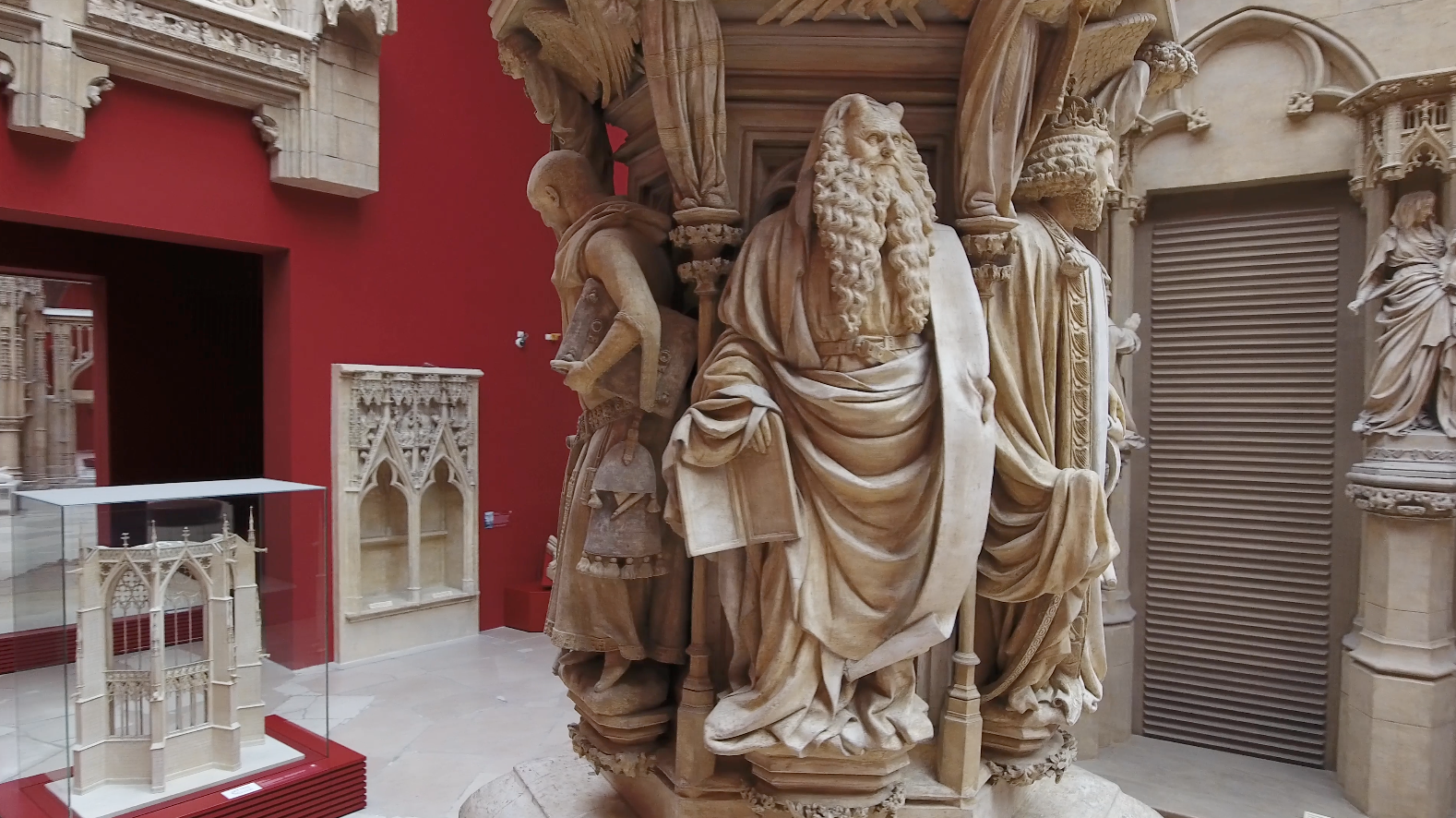
Regarding architecture, they allow us to recontextualize fragments. We often display parts of buildings – gates, facades, models – and digital tools help us to show how those pieces fit into a larger architectural structure.
Augmented reality is particularly interesting for this. For example, when we display a life-sized cathedral gate, the digital media can be used to place it back onto the original edifice while rendering its volumes.
There’s also a more sensory dimension. Museums have traditionally focused on knowledge transmission. Using digital and immersive media, we can play with spaces, flows, scales or functions.
For example, we’re currently working on a model of an 18th-century private mansion. Using digital integrations we can show the building’s organization, private rooms, flows of domestics, and the function of various rooms. Those elements would be much harder to convey through traditional mediation.
How does digital media incorporate into the already transdisciplinary approach of the Cité de l’architecture ?
R. S. – There’s a lot of ways. What I think is particularly stimulating is the prospective dimension.
Of course, we tell the history of architecture. However we also have content elements that can be used to create immersive experiences that allow us to walk through the city of tomorrow. For this type of project there can obviously be a scientific approach, with very factual projections, but also a completely aesthetic approach. Artists can use our content to create more poetic virtual experiences that help to imagine how we will build, occupy, and live together in the world of tomorrow.
What are the main challenges faced when developing digital devices and installations in a cultural institution ?
R. S. – One of the biggest challenges is to find a framework that enables cooperation between all the Cité’s teams and their specific competences. A quality project mobilizes scientific expertise, mediation, interactive storytelling and digital design within the same process.
We’re also convinced that our public needs to be at the center of our offer’s production. We need to stay in touch with our visitors’ needs and wants. In the case of our Architecture Augmented project, we put together a visitor committee composed of members of all ages, more or less familiar with museums and digital technologies. Rather than reacting only to a finished project, this committee has been involved from the earliest stages of conception. Everything can still be brought into question: the language used, the narration, ergonomy or the functionality of the devices. It is an enriching process that we would like to systematize.
Accessibility is another major issue. For Architecture Augmented we would like to use the mobilized means to create a fully accessible installation. It is a major challenge that requires taking into account a wide range of disability scenarios.
Finally, there is a balance to be found between our public service mission of making culture accessible to as large of an audience as possible, with the necessity of having a resilient financial model. This comes with a compromise between scientific rigor and product attractiveness, that leans one way or another depending on the project. However, we always leave pure entertainment to the structures that specialized in it. We are still a national cultural institution and our main mission is to display tangible and material pieces to the public.

What are some aspects or collaboration that you would like to develop in the coming years ?
R. S. – There’s a digital revolution at all levels in the architecture field. It impacts mediation as well as the profession itself. Nowadays, a number of models are created through digital tools and architects incorporate new technologies in their practice (testing of architectural hypotheses, documentation of heritage edifices’ states, demonstration of the project’s workings before construction).
We would like for the Cité to become a meeting place for architects, researchers and technology editors as well as artists and cultural industries specialists such as video games or cinema. Thus, we wish to become a kind of project catalyst, while presenting the resulting product to an audience. This could be accomplished thanks to our spaces – more than 22 000m² – that allow us to house experimentations, prototypes and proofs of concept.
Discover more interviews with curators and programmers on our blog.