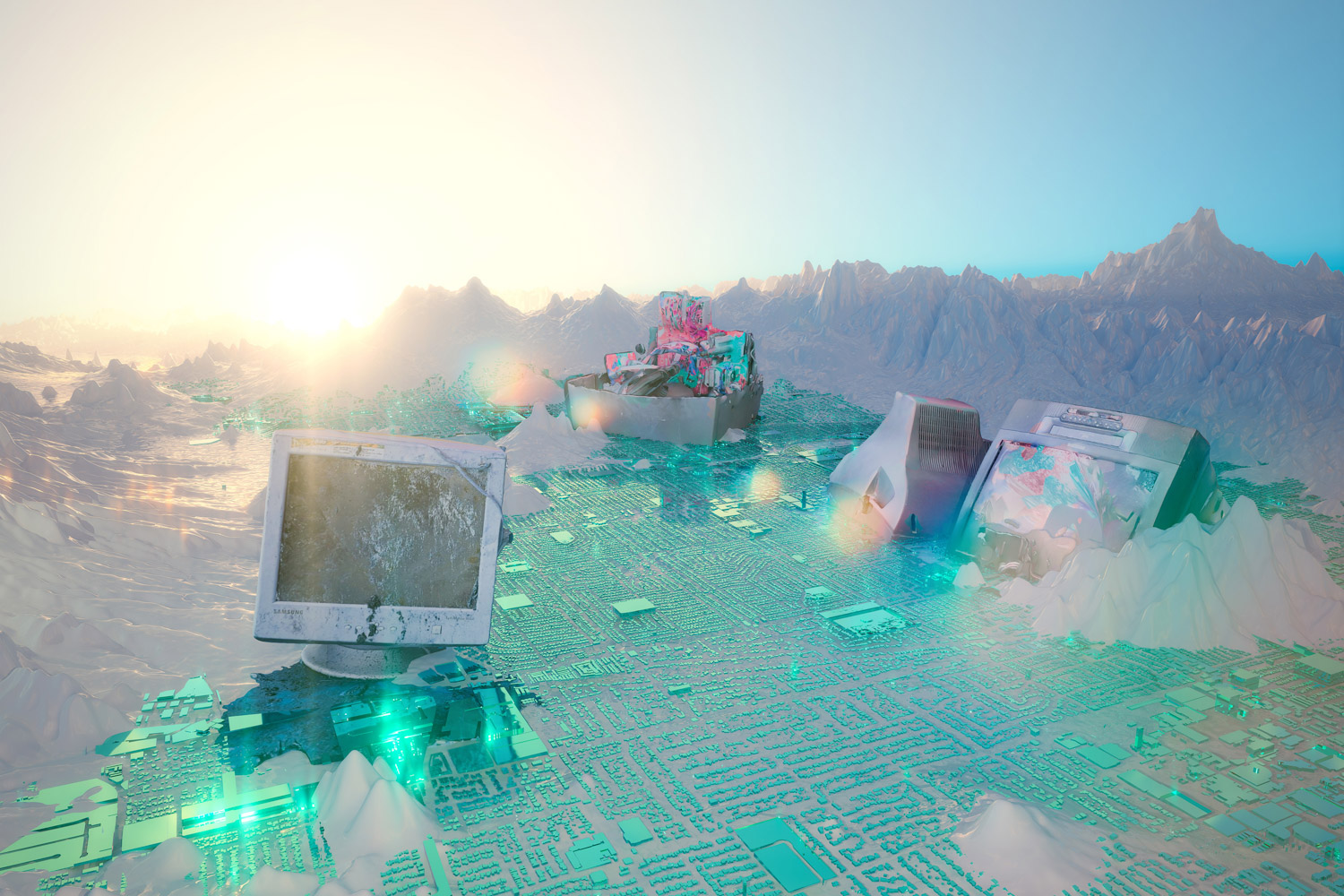
Unframed Collection partners with NUMIX Lab, an itinerant European event that brings together immersive creation professionals in dialogue with cultural institutions across the continent. The 6th edition in 2025 brought together 459 participants from around the world across 16 venues in Budapest, Veszprém, Vienna, and Linz, fostering exchanges between Europe and North America around immersive cultural practices.On this occasion, we met Marie Béraud, Development & Partnership Project Manager at Le Cube Garges, a 10,000-square-meter cultural and artistic innovation hub located in the northeast of Paris, in Garges-lès-Gonesse. Designed as a hybrid space bringing together exhibitions, live performance, cinema, artistic practices and digital mediation, Le Cube Garges develops a deeply transversal approach to immersive arts, at the crossroads of artistic, social and territorial challenges.In this interview, Marie Béraud reflects on the Cube’s vision of immersion, on how this unique environment enables disciplines to intersect, and on the challenges of integrating these technologies within a strong framework of inclusion and public engagement.
“We have a very concrete challenge: to make digital technologies a space for mediation, participation and inclusion. This is what we try to do through this interdisciplinarity and the diversity of practices we offer, whether they are digital, artistic or educational, and through a programming that is itself very hybrid.»– Marie Béraud
Le Cube Garges is a unique space in terms of the diversity of its facilities. Could you describe the venue and how it operates?
Marie Béraud – Le Cube Garges is a 10,000-square-meter cultural and artistic innovation hub, located in the northeast of Paris in Garges-lès-Gonesse, which brings together in one single place six cultural facilities, including an exhibition hall where we present digital art exhibitions, a large venue with 600 seats and up to 1,000 standing capacity where we can host all kinds of performances and immersive experiences, but also a cinema, artistic practice spaces, a recording studio, a FabLab and a media library.We are really a highly hybrid place, which operates almost like a conservatory with the city’s cultural department, where we welcome very diverse audiences – young people, families and local residents – who come to train in both artistic and digital practices.The idea is really that someone entering the Cube can experience multiple things in one place: access a digital exhibition, attend an immersive performance, take part in a workshop in the FabLab, and then go to the cinema. This idea of circulation between disciplines and experiences is central to our project.
What vision of digital arts and immersion do you defend at Le Cube Garges?
How do immersive projects respond to your social and territorial ambitions?
M.B. – Le Cube has a strong history in digital arts – it is actually the first digital creation center in France – so we have this pioneering dimension, but when we moved to Garges-lès-Gonesse, we really changed scale, with a much stronger social dimension.We are located in a priority area where 85% of the population lives in priority urban districts, with a very young population – more than 50% under 30 – and more than 70 nationalities and languages represented.So we have a very concrete challenge: to make digital technologies a space for mediation, participation and inclusion.This is what we try to do through this interdisciplinarity and the diversity of practices we offer, whether they are digital, artistic or educational, and through a programming that is itself very hybrid.
What formats or collaborations would you like to develop around immersion?
What types of immersive or digital projects are best suited to your highly modular spaces?
M. B. – At Le Cube, we really welcome all forms of immersion, and we are even launching the first edition of a festival dedicated specifically to immersive practices.As I mentioned earlier, we see immersion not only as something technological but also as something sensory, auditory and participatory, so all forms of immersive experiences can find a place within our spaces.What we will particularly focus on are 360° and multi-user formats, especially in VR, because we want to make technology a tool for social connection, with a strong collective dimension.But overall, we remain open to all types of immersive experiences, and this first edition of the festival will be an opportunity for us to showcase this diversity and to develop new collaborations with digital artists.
What are the main challenges and opportunities for strengthening immersive practices at Le Cube Garges?
M. B. – The challenges are numerous: technical challenges, because we need to equip our spaces to host the latest immersive innovations; financial challenges, because these technologies are costly; logistical challenges, because these installations can be complex; and also challenges related to mediation and inclusion.The goal is really to guide audiences as well as possible and to ensure that people who take part in these experiences can truly gain something from them.At the same time, we have strong assets: very large and modular spaces, a programming and mediation team that is very committed to these issues, and a territory that is extremely young, dynamic and cosmopolitan, which we consider as a “city of the future.”We have also launched an impact lab to measure the impact we have on the territory, particularly regarding the tensions between digital ethics, youth engagement and environmental responsibility, and we are currently recruiting a PhD researcher to work on these questions.
Discover more interviews with curators and programmers on our blog.
Views:872
Our site uses cookies. Learn more about our use of cookies: cookie policyACCEPTREJECT
Privacy & Cookies Policy
Privacy Overview
This website uses cookies to improve your experience while you navigate through the website. Out of these cookies, the cookies that are categorized as necessary are stored on your browser as they are essential for the working of basic functionalities of the website. We also use third-party cookies that help us analyze and understand how you use this website. These cookies will be stored in your browser only with your consent. You also have the option to opt-out of these cookies. But opting out of some of these cookies may have an effect on your browsing experience.