

From augmented concerts to immersive operas, interactive experiences to spatial sound compositions, an increasing number of composers are turning to virtual reality. Not as a mere technological tool, but as a new space for writing, perception and experimentation.
When Billie Eilish announced her collaboration with James Cameron to create an immersive capture of her live performances, the news initially sounded like a feat of technical engineering. Yet behind the encounter between one of today’s biggest pop artists and one of cinema’s most innovative filmmakers lies a deeper question: what can immersion bring to the musical experience?
In many ways, music has always sought to extend beyond the act of listening alone. Opera, multimedia performances, concert scenography and music videos all reflect the same ambition: to give visible form to what, by its very nature, remains invisible.
Virtual reality continues this tradition while introducing a fundamental shift. For the first time, audiences can do more than watch or listen to a work – they can step inside it: move through a sonic landscape, manipulate a composition, share the performer’s point of view, or follow a musical score that unfolds as a space.
Across projects as diverse as Playing with Fire, Ça vous dérange?, In Pursuit of Repetitive Beats, From Dust, Insider-Outsider, The Eye and I, Silence(s), paysages du vide, and The Metamorphoses of Guernica, a common intuition emerges: virtual reality brings audiences closer to the very gestures of musical creation.
Beyond the Concert: Interpretation and the Musician’s Gesture
A concert is, in many ways, a paradox. Its emotional power rests on something essentially invisible.
Audiences hear an interpretation without ever fully accessing what produces it: the musician’s mental imagery, their reading of the score, the emotions embodied in each gesture, or the intentions they seek to convey.
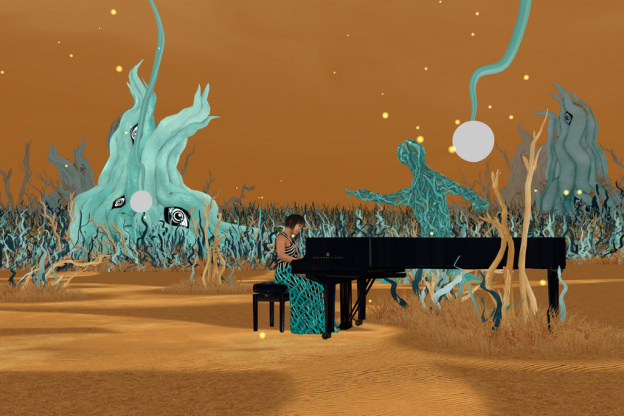
It is precisely this intimate space that Playing with Fire, created around pianist Yuja Wang by the Philharmonie de Paris, seeks to explore. Rather than illustrating the music, the experience extends the concert itself, giving visual form to the performer’s inner world and to a deeply personal interpretation. A similar ambition to make the artists’ inner world perceptible can also be found in DeLaurentis Immersive, currently presented at the Cité des sciences et de l’industrie in Paris. Inspired by the album Musicalism, the VR experience invites visitors to journey through a succession of dreamlike landscapes, where luminous textures and sonic architectures come together to create a deeply sensory cartography.

This desire to make the invisible visible belongs to a long history of correspondences between the arts. Kandinsky, for instance, searched in painting for the equivalent of musical harmonies. Today, immersive technologies make it possible not only to represent these correspondences, but to inhabit them.
In Ça vous dérange?, conceived by Julien Masmondet and Ensemble Les Apaches!, another dimension of the concert comes into focus. No longer seated before a distant orchestra, the audience moves inside the musical experience itself. Positioned among the performers, visitors notice gestures, glances and subtle interactions that usually escape the stage. Here, images do not illustrate the music; they extend its evocative power in a work that invites us to listen to – and look at – nature and the rural world.
This immersion at the very heart of the orchestra is also central to the virtual reality productions developed by Insula Orchestra – the resident orchestra of La Seine Musicale, under the artistic direction of Laurence Equilbey. Experiences such as Mozart 360, Beethoven 360 (directed by Ivan Maucuit) and Archi Beethoven (directed by Philippe Monerris) place the audience among the musicians, transforming listening into a spatial and sensory experience in which the image enhances the music without ever overshadowing it.
“The visual dimension contributes greatly to auditory understanding. Most of the projects developed by Les Apaches are enriched by visual elements for precisely this reason. I believe art has come to understand that the sounds of nature are themselves a form of musical material. Showing how an orchestra functions is also a metaphor for society, inviting reflection on living together.
For an orchestra to work well, musicians must constantly listen to one another. Revealing their work also helps audiences understand how composers use – and sometimes divert – instruments to create entirely new sound worlds.”
– Julien Masmondet
When the Senses Respond to One Another
“Like prolonged echoes mingling in the distance…
Perfumes, sounds, and colors correspond.”
– « Correspondances », Les Fleurs du Mal, Charles Baudelaire, translated by William Aggeler
In In Pursuit of Repetitive Beats, Darren Emerson does not simply recreate the British rave scene of the late 1980s. He seeks to recover what made it so elusive: its collective energy, its relationship to time, and its unique way of inhabiting space and the night.
Electronic music plays a fundamental role. It does not comment on the narrative – it becomes its very substance. Images provide context, but sound generates the feeling of presence. Together, they recreate not simply a historical period, but a sensory memory – even for those who never experienced it.
This ability to evoke another place – and another state of being – finds a different expression in From Dust by composer and theatre director Michel van der Aa. Opera has often been described as a total artwork because it has always brought together multiple artistic languages: music, text, scenography, light, performance and, at times, dance. With From Dust, van der Aa extends this ambition into immersive media. Rather than juxtaposing disciplines, the work fuses them into a single perceptual experience, where virtual reality becomes less a technological device than a new kind of stage.
Inside the Music: Understanding Composition
Virtual reality does more than change the way we listen. It can also reveal how music is constructed. This is one of the most distinctive aspects of Insider-Outsider, imagined by Philippe Cohen Solal from the visual and literary universe of Henry Darger.
The work itself already brings together multiple artistic languages: Darger’s drawings, his monumental novel The Realms of the Unreal, the song lyrics embedded within it, Philippe Cohen Solal’s musical composition and the immersive environment.
Yet the experience goes beyond this fusion of forms. Throughout the journey, visitors progressively activate different instruments, discover the layers that compose a melody and alter certain musical elements through their own gestures. Music ceases to be a finished object and becomes instead a living process that can be explored and influenced.
“What we’ve managed to create with this interactive musical VR experience is precisely that possibility of interacting, of feeling a little like a musician, a little like a painter – and of escaping.”
– Philippe Cohen Solal
The quote captures one of virtual reality’s most stimulating promises for music. It is not about turning audiences into composers, but allowing them – even briefly – to experience some of the mechanisms behind musical creation. Unable to play the music itself, we play with it, transforming listening into an active, embodied experience.
At the Boundaries of Listening
For other artists, virtual reality functions above all as a laboratory. Jean-Michel Jarre belongs to a generation of creators who have always regarded technology not as an end in itself, but as a means of renewing artistic language. With The Eye and I, he continues this exploration, imagining an experimental work in which VR becomes a space for testing new relationships between sound, image and perception.
The same curiosity drives Silence(s), paysages du vide, developed by Akousthea. The project begins with a paradoxical question: can silence itself be heard? By inviting audiences to attend to phenomena that usually remain imperceptible, the work reminds us that listening is never passive; it is another way of inhabiting the world.
Composing Space and in the Space
Even when music is not the central subject of an immersive experience, it often remains one of its essential components.
Composing for virtual reality means abandoning one of cinema’s fundamental principles: the frame. In film, directors determine what audiences see. In immersive experiences, visitors are free to look anywhere. Sound therefore becomes not only a vehicle for emotion but also a means of orientation.
As director Nicolas Thépot explains about The Metamorphoses of Guernica, whose original score was composed by Rémi Boubal:
« Dans le média VR, le son prend énormément de place et est un indice de plein de choses, qui racontent le hors champ, qui nous invitent à nous retourner, à découvrir les espaces sous tous les angles. »
– Nicolas Thépot
– Nicolas Thépot
Cette évolution transforme profondément le travail des compositeurs. Ils ne construisent plus seulement une progression musicale ; ils organisent une circulation dans l’espace.
Les créations développées actuellement autour du Fabuleux voyage de Charles Darwin par Jérôme Baur et Côme Jalibert illustrent elles aussi cette mutation. Le recours au son binaural, à l’ambisonie ou à d’autres techniques de spatialisation oblige à penser la composition autrement, à écrire dans le temps mais également dans l’espace.
Cette évolution, Jérôme Baur l’évoquait déjà à propos de sa première création immersive, Archi VR – La Villa Savoye :
« Après trente ans à composer pour l’image, cette première création pour la VR m’a fait entrevoir une approche différente ainsi que d’autres possibilités techniques au service du récit. »
La formule résume bien l’enjeu : composer pour la réalité virtuelle ne consiste pas simplement à déplacer des outils existants vers un nouveau support. Il convient d’apprendre à écrire pour un spectateur libre de ses mouvements, dont le regard n’est plus guidé par le montage mais par l’ensemble des éléments qui composent l’expérience.