

What can virtual reality tell us in the face of the climate crisis? How can phenomena as complex as floods or the disappearance of wetlands be transformed into an experience that resonates on a deeply human level?
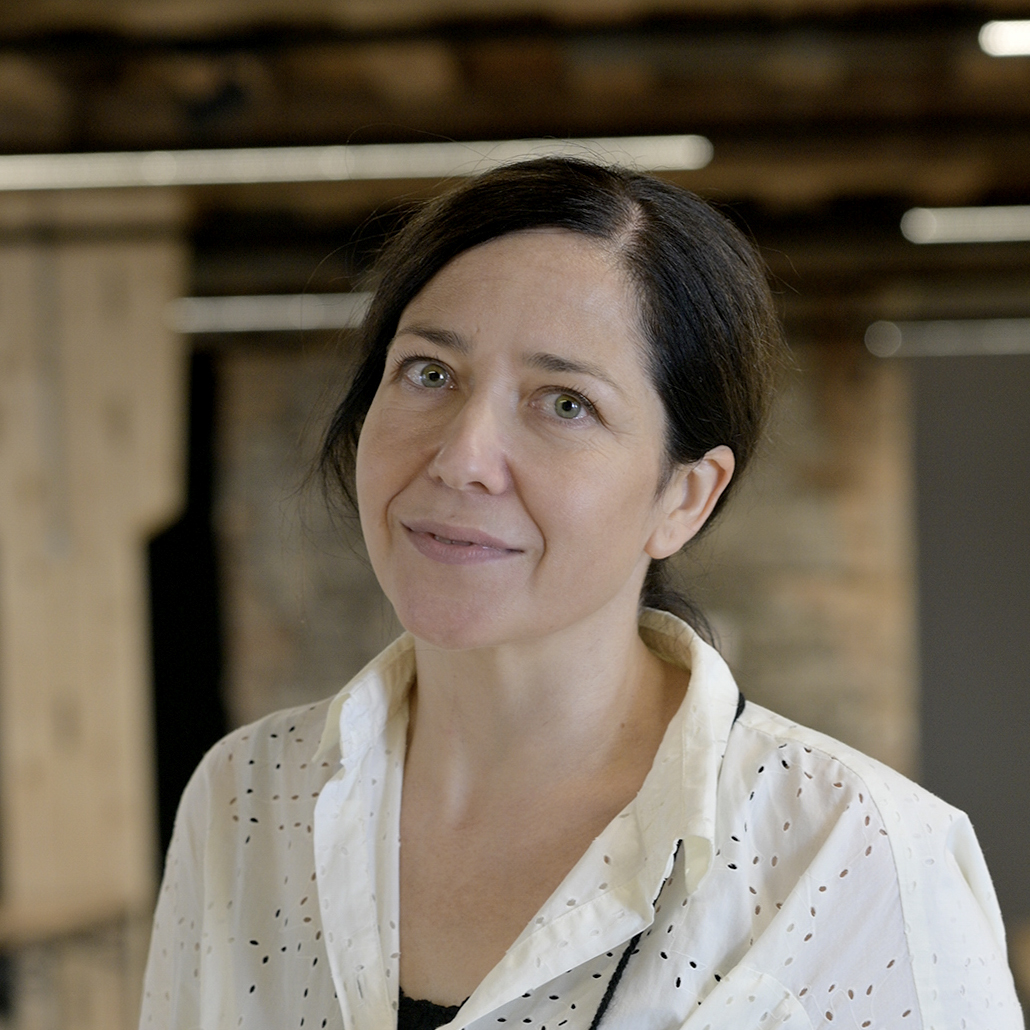 For more than fifteen years, Kris Hofmann has explored the potential of immersive media to tell stories, share knowledge and inspire awareness. Trained in animation at the Royal College of Art in London, she has created numerous augmented reality experiences for young audiences while collaborating with the Austrian Institute of Technology on the uses of emerging technologies. Out of Nowhere marks her first virtual reality film.
Inspired by the devastating floods that struck Europe in 2021, the experience follows Anna, a lifelong resident of Hallein, whose intimate story opens onto a broader reflection on our relationship with rivers, landscapes and the living world.
Through a delicate hand-painted aesthetic, Out of Nowhere contrasts the quiet beauty of floodplain forests with the destructive force of rising waters. Shifts in scale, interactivity, spatial sound and the viewer’s physical presence become storytelling tools that make an often distant or abstract reality tangible. Here, technology is never used for spectacle; it serves the narrative, fosters empathy and brings pressing environmental issues into sharp focus.
Kris Hofmann talks about the origins of this singular work, her artistic approach, and her conviction that virtual reality can raise awareness without ever sacrificing poetry.
“Part of the reason for choosing VR was the hope that, by letting people step into the shoes of someone who lived through an extreme weather event, the subject might become less abstract and more immediate.”
– Kris Hofmann
From personal memory to collective experience
Out of Nowhere is rooted in a personal memory: the floods that struck Europe in 2021. How did this experience evolve into an immersive work that intertwines individual memory with collective reality?
People connect more easily to personal stories. Journalists, writers and documentary filmmakers work with this all the time, and I think immersive storytelling is no different. So I travelled to different places affected by the 2021 floods in Europe and started speaking to people about their experiences. Eventually, I found a personal story that I felt could be powerful in VR, and that gave us an anchor for the larger ecological story.
The Biennale College also played a big role in shaping the work. Abigail Addison, our coproducer, and I took part in the XR residency in 2023, and it really helped us develop the experience.
What led you to choose virtual reality as the medium for this project?
It seems like we have now moved beyond outright climate denial in Europe at least. But people still don’t seem to feel a real sense of urgency, especially when it comes to climate solutions, or even just protecting ourselves from the consequences that are already happening.
So part of the reason for choosing VR was the hope that, by letting people step into the shoes of someone who lived through an extreme weather event, the subject might become less abstract and more immediate.

Nature between wonder and devastation
The river depicted in the experience shifts between serenity and threat, beauty and destruction. How did you craft this visual and sonic tension to convey nature’s duality, as both a refuge and an uncontrollable force?
The frequency and severity of floods is compounded by climate change, but also by the way we have confined rivers into narrow, controlled corridors over time.
One of the key moments in the experience is the contrast between water as a destructive force inside Anna’s (our main character’s) front room and throughout Hallein, and water in a flooded alluvial forest – the place nature designed to absorb excess water when it comes
We worked with space and ambisonic sound to create that tension. First, you experience the flood, locked inside a narrow room with the water rising around you. There is a sequence of about thirty seconds where we turn the light off completely, so the whole scene is carried by sound. The room starts to feel smaller and smaller, just through the sound of the water rising around you.
And then we contrast that with the forest, which feels open, airy and alive. When water floods a riparian forest, there is nothing inherently frightening about it, apart from maybe a few mosquitoes. It is almost the opposite. These places are magical, biodiverse safe havens for many different species, and help protect communities at the same time.
A Dreamlike Aesthetic Confronting a Concrete Reality
Out of Nowhere unfolds with a poetic aesthetic – slow pacing, light, the rustle of water and leaves, blending childhood memories with the almost magical beauty of floodplain forests. Why did you choose this dreamlike graphic approach ?
One reason was narrative-driven. We didn’t want the flood to be announced too early, or for the beginning to feel full of foreboding. We wanted the flood to arrive suddenly, almost out of nowhere.
The slower, more poetic beginning gives the audience time to get to know Anna and to connect with her and the town of Hallein before the experience shifts.
More generally, I’m a firm believer in the power of a handcrafted aesthetic. All the textures in the project were painted by hand, and those small imperfections reveal a human presence behind the experience. I think that matters in VR. The hand-painted approach gives the world a tactile quality, which I hope makes it easier for people to connect emotionally with the world of the experience.
Distribution and reception
What were the most striking or unexpected audience reactions you’ve witnessed so far?
We’ve had really positive reactions to the piece so far, and a lot of interesting conversations that followed. Especially at SXSW, we spoke to a wide range of policy makers, educators and documentary filmmakers who felt that the subject matter and the use of VR worked well together, which was really rewarding.
The most surprising – and perhaps the most enjoyable – reactions came from children. Even when they didn’t fully get every aspect of the story, they loved exploring the world, touching the water, and moving through the forest. They were sometimes genuinely disappointed when the Meta boundary appeared and they realised they couldn’t walk any further. Andreas (technical director) and Max (sound designer) did such a terrific job with the water and the atmosphere of the forest. It’s a joy to watch children respond to that, and to see how naturally they engage and interact with the piece.
After its world premiere at the Venice Film Festival, beyond the festival circuit, in what other contexts or venues would you like to present Out of Nowhere ? Which audiences would you like to reach and how would you like to impact them ?
The successful festival run made us very proud and happy, of course, but it’s also really important to us that the piece is presented in contexts, where the focus is less on the creative and/or technological qualities of the work, and more on the impact. At its heart, Out of Nowhere is a story about the need to look at what can be done locally to protect ourselves from the worst consequences of climate change.
The piece is short, accessible, and quite easy to present, and we found that it works well in schools, environmental education programmes, and conferences around climate and ecology.
We have already shown it in a few of those settings, including at a Youth Climate Action Summit in Cornwall, Ontario, and schools in Germany and Austria. One teacher wrote to us afterwards to say that they had used the experience as the basis for a creative writing class, which we found very moving. I think the whole team would love more opportunities like that, where the piece becomes a starting point for conversation, reflection, or even creative work around climate, and how we live with our rivers.
Somewhere between a contemporary fable and an environmental plea, Out of Nowhere reminds us that responding to climate change is not only about human innovation, but also about our ability to reconnect with the natural systems that have long protected us.
The experience is currently presented in France in the libraries of Carré d’Art in Nîmes, the Perpignan Urban Community, and Biblio64, the Departmental Library of the Pyrénées-Atlantiques.
Discover more interviews with creators on our blog.