
Oto and Skippy lead a peaceful life on their little planet, rhythmed by napping and harvesting. Until Exo’s arrival, a stranded cosmonaut that raises his flag, claims part of the land and ends up erecting a wall. This is the beginning of Oto’s Planet, an interactive fable that turns this tiny world into a playground where cohabitation, borders and resources appropriations mechanisms can be observed with humour and satire.
Luxembourg-based French director and Skill Lab co-founder Gwenael François work is a junction between cinema and immersive technologies. After first discovering VR in 2017, it’s Arden’s Wake: Tide’s Fall from Penrose studio that made him realise the visual and narrative possibilities of the medium and give birth to the first ideas for Oto’s Planet.
Awarded the Special Jury Prize at Venice Immersive in 2024 and the Reflet d’Or at GIFF the same year, the experience has since continued its remarkable international journey. In this interview Gwenael François revisits the creation, the technical choices, and the particular tone of this story.
In my story, satirical humor is used to point out the absurdity of social or political conventions and to transform a small planet into a microcosm where human vices (greed, the need to mark one’s territory) are magnified and made laughable.
— Gwenael François
You have directed VR experiences for several years now. What attracted you to this medium? What does it bring to your works, and to Oto’s Planet, especially?
VR is first and foremost a tool of total immersion. It places us at the heart of the story, which creates a way stronger emotional connection to characters and themes. It is what allows us to touch the viewer in a deeper way: we do not only watch the story, we live it.
What radically differentiate VR from other classical narrative mediums such as cinema, theater, or literature, is interactivity. In Oto’s Planet, it is precisely this lever I wanted to activate to break the fourth wall. Interactivity is not a gimmick, it allows the creation of this direct, almost tactile, bound between the user and the character, making their presence that much more real and tangible
Beyond my own project, it’s the medium as a whole that captivates me. To be part of those that are, at this very moment, writing a new narrative grammar, inventing a language that didn’t used to exist. It’s an incredibly exciting time for a director, and it’s a privilege to be able to participate in such an exploration, in real time.
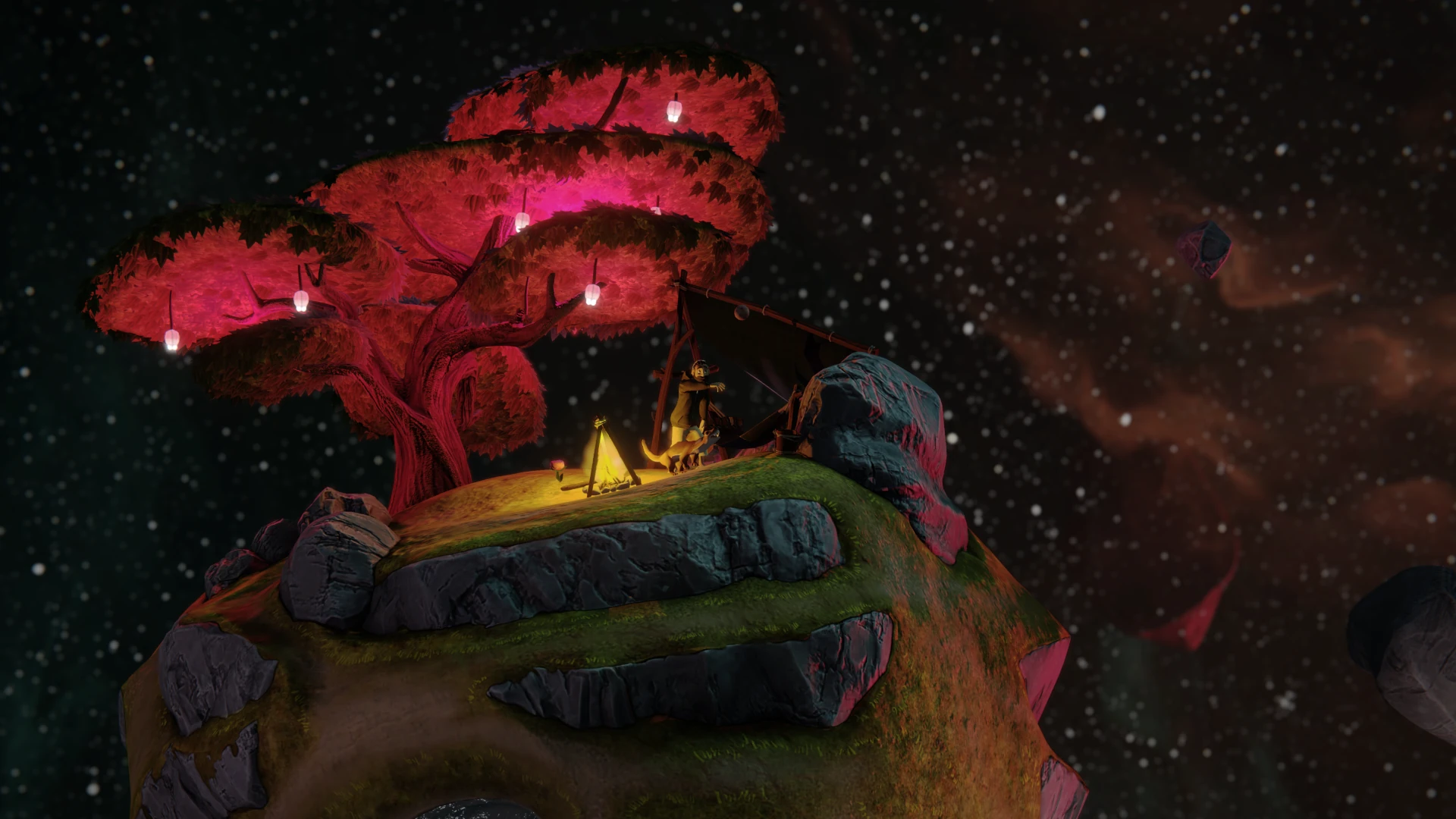
VR tends to put the user at the action center. Oto’s Planet makes another choice: faced with a planet he can manipulate, enlarge or turn every which way, the user stays on the outside, almost an omniscient observer. Where does this choice of scale and point of view come from? What does it bring to the story?
This choice is born out of the meeting of an aesthetical aspiration and a technical constraint, which is quite common in VR creation.
On, the artistic plan, I was deeply inspired by works that brilliantly explored this reduced scale, such as Arden’s Wake by Eugene YK Chung, Gloomy Eyes by Fernando Maldonado and Jorge Tereso or The Line by Ricardo Laganaro. There’s something fascinating about this idea of a “living diorama”: it creates an immediate intimacy and gives a viewer an overview, as if they held the characters’ destiny between their hands.
But to be realistic: it’s also an indispensable production strategy. By choosing this scale, I can concentrate the processing power on characters and textures. It allows for a high level of details even in a standalone format with limited computing capabilities. By keeping a “contained” universe, I offer the viewer rich and detailed visuals without ever sacrificing fluidity, which is the foundation of immersion.
Finally, this omniscient point of view perfectly serves the narrative: by placing the viewer outside of the action, we create critical distance, not unlike a strategic game player. It is precisely this “outsider” position that allows for the satirical tone of the story and to observe the absurdities of the characters’ behavior with a necessary remoteness.
Oto’s Planet includes interaction phases (making a fruit fall, bringing back a shovel…) that do not directly impact the story, although it creates a kind of bond between the user and Oto. Why did you include those interactions? What is their goal?
The goal is never to complexify the experience through “gameplay” in the ludic sense. These interactions are, most of all, subtle narrative devices. The goal is to create a bridge, a complicity between the viewer and Oto. By allowing the user to perform simple gestures – like making a fruit fall or handing him a tool – we release them from their passivity of pure spectator to make them a benevolent actor within the universe.
Interactivity isn’t a means to “win” but to “feel”.
— gwenael François
This creates an immediate empathetic relationship: we start to help Oto, we take care of him and this creates an emotional attachment. It’s precisely this relationship of trust that m=ake the arrival of the second character, Exo, and the developments of the story that much more impactful. If the user invests time and attention into “helping” Oto, the stakes of cohabitation, appropriation and the border becomes that much more concrete and emotionally charged.
Oto’s Planet narration is based on a quite satirical humor that brings to mind Adam McKay’s writing (The Big Short, Don’t Look Up…). What were your inspirations in creating this experience?
To be truly honest, this satirical tone wasn’t intended from the start: I didn’t write the experience with the primary objective of making it humoristic. However, as time went by the narrator’s voice rapidly found this quirky, satirical, tone that immediately spoke to me.
In my story, satirical humor is used to point out the absurdity of social or political conventions and to transform a small planet into a microcosm where human vices (greed, the need to mark one’s territory) are magnified and made laughable.
Oto’s Planet deals with numerous themes in more or less frontal ways (colonisation, appropriation of resources, the creation and setting up of borders) that are handled differently in France and Canada, due to the history of those two countries. What did you take away from your participation in the Atelier Grand Nord XR 2021 and your collaboration with Dpt.? How did this participation influence the experience?
The Atelier Grand Nord XR was a great opportunity to confront our writing to a panel of experienced professionals. Our attendance to this workshop was decisive in the improvement and refining of our writing. During the AGN XR 2021, which, sadly, had to take place online because of the pandemic, we met the Dpt. team that was there to present another project. This meeting was the departure point of our collaboration on Oto’s Planet.
Thanks to this partnership, we have been able to finance and produce part of our assets in Canada, and, most importantly, to develop a performing transatlantic workflow. The contribution of Dpt. was essential to the integration into the Unity engine, especially when it came to conceive the interactions with Oto as well as the implementation of the planet rotation through a simple hand gesture.
When it comes to the theme of borders, the idea was born well before this meeting. It’s really the current situation between the US and Mexico that inspired the idea of placing a physical border at the center of our two protagonists’ relationship.
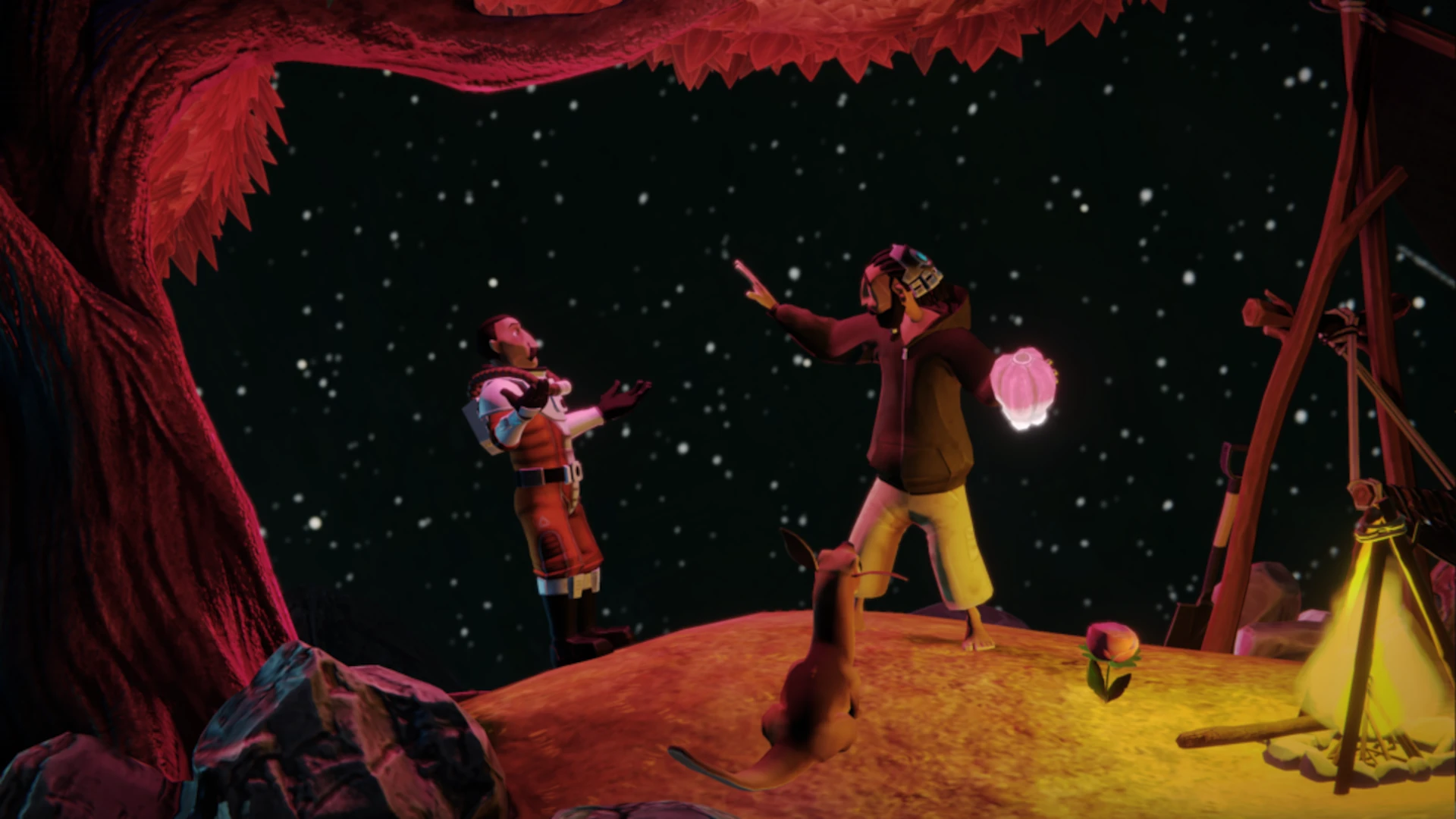
The synopsis for Oto’s Planet, on a number of websites (La Biennale di Venezia, Cannes Film Festival, Villa Albertine…) make use of children’s tales narrative codes, evoking communication, cohabitation and even reconciliation. This presentation doesn’t necessarily let through the satirical and political dimension of the experience. Was it a way of subverting audience expectations? What were your targeted audience and how did this impact the work reception?
It’s not a deliberate will of deceiving the audience, but more so a choice to make the experience as widely accessible as possible. In truth, Oto’s Planet is designed to touch a large audience with several levels of interpretation. On one hand the “tale” and visual aspects allow any viewer to let themselves be carried by the story. On the other, the satire and political backdrop add another dimension for those that wished to dig deeper into the themes of cohabitation and borders. Therefore, it’s not a subversion but an invitation: everyone is welcome in Oto’s world, no matter the depth to which you seek to explore the narrative.
Beyond this intent, I was able to observe that it works perfectly for all audiences even the youngest, everyone is really receptive to this type of story. In festivals, it was a real pleasure to see people smile and laugh when they experienced it. When it comes to the industry reception, I couldn’t be more appreciative and grateful: the project travelled the entire world and was selected in 63 festivals and awarded 14 times, including a Lion in Venice (2024 Special Jury Prize).
Editor’s Note : The next part of this article discusses important plot points that will impact the viewing experience. Discover Oto’s Planet, before learning more about its creator’s vision!
The end of the experience is an unexpected plot twist that takes on a completely different facet of the planet. What did you seek to express through it? How does it tie back to the themes explored throughout the experience?
During writing, I felt it would be really interesting to catch the viewer off-guard by offering this unexpected twist. In our narration, we wanted to demonstrate that a black-and-white vision of the world, where things are simply deemed as “good” or “bad” is always false, even dangerous. This twist is used to reveal that reality is much more complex. With Exo’s death and the reveal of the planet’s insides we understand that this death is only another in a long line, taking Oto from his role of colonised victim to one of a willing gravedigger of this perverse system.
Beyond the surprise, this ending expands on the idea of cycle. It illustrates the futility of the barriers and borders set up by the characters: what’s the point of dividing a territory if we do not realize that space is limited and destiny is shared? It highlights the absurdity of this conflict, that traps us in infinite repetitions when survival depends on our capacity of surpassing these divides.
Discover more interviews with creatives on our blog.